The most common objection to GPS-based worker positioning in construction safety goes like this: "We tried a GPS badge system in 2021. The accuracy was garbage on our site and we stopped using it." That objection is valid. Consumer-grade GPS on a dense urban site surrounded by glass towers, steel structure, and heavy equipment achieves accuracy of 3-8 meters due to signal multipath. For geo-fenced exclusion zones with 2-meter boundaries, that's not a positioning system — it's an expensive guess.
BLE mesh positioning solves the multipath problem by using locally anchored reference points rather than satellites 20,000 kilometers away. Here's why that matters technically, and why the architecture choice is non-negotiable for interior and dense-site construction environments.
GPS multipath and why construction sites are the worst case
GPS positioning accuracy depends on clear line-of-sight to four or more satellites with good geometric dilution of precision (GDOP). Urban construction sites systematically violate this requirement. A dense commercial site in a downtown area may have glass-clad skyscrapers on three sides, reflecting GPS signals and creating phantom signal paths that arrive at the receiver with 50-200 nanosecond delays relative to the direct-path signal. At the speed of light, 100 nanoseconds of path delay corresponds to 30 meters of apparent position error.
Steel structure on the site itself adds another multipath source — crane towers, structural steel erection, and metal deck installation all reflect GPS signals. Above-ground rebar-reinforced concrete walls create partial sky blockage. The result is a GPS environment that's hostile in ways that open-field GPS testing never reveals.
GPS-based safety systems deployed in outdoor greenfield environments — highway projects, open land development, utility trenching — perform reasonably well. Those environments have clear sky view and minimal reflective surfaces. On a 15-story downtown high-rise project, GPS is the wrong technology for 2-meter precision positioning regardless of what the manufacturer's spec sheet says.
How BLE mesh positioning works
BLE (Bluetooth Low Energy) mesh positioning uses a network of fixed anchor nodes installed around the site. Each anchor transmits a Bluetooth beacon signal. Worker wearables receive signals from multiple anchors simultaneously and trilaterate their position based on received signal strength (RSSI) and time-difference-of-arrival (TDoA) measurements from the anchor mesh.
Accuracy in a well-anchored BLE mesh is 1-2 meters in favorable conditions — 30-50 meters of wall-penetration for indoor positioning, with accuracy degrading predictably at the edges of anchor coverage. That's a meaningful improvement over 3-8 meter GPS accuracy on the same site, and the accuracy is consistent indoors and outdoors without GPS-specific degradation in reflective environments.
Our site deployment uses anchor spacing of 25-35 meters for outdoor environments and 15-20 meters for interior areas. A 100,000 square foot floor plate requires approximately 18-24 anchor nodes to achieve 2-meter accuracy across the floor. Anchor installation takes 3-4 minutes per node using our magnetic mounting hardware; total indoor floor instrumentation is typically accomplished in 90-120 minutes per floor by a 2-person team.
The hardware: what the wearable actually is
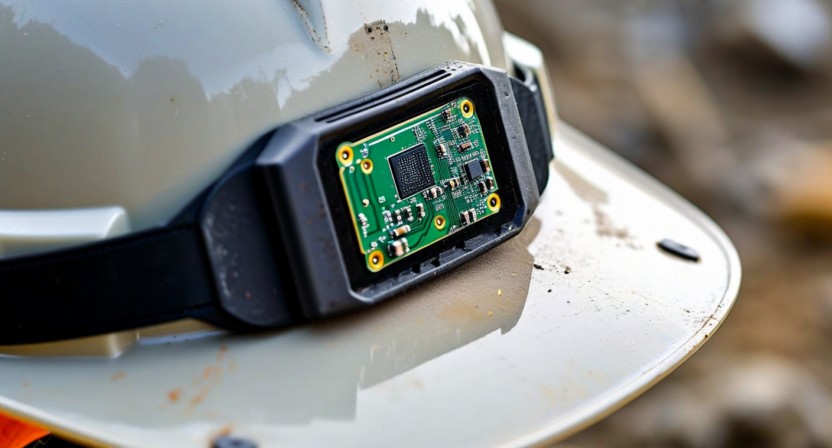
Our wearable sensor is a 45-gram clip that attaches to standard ANSI Z89.1 hard hats via the suspension brim. It includes a BLE 5.2 radio, a 3-axis accelerometer/gyroscope IMU, a barometric pressure sensor for elevation tracking, a 600mAh battery with 14-hour runtime at standard usage, and a haptic vibration motor for worker-side alert feedback.
The BLE radio transmits a positioning beacon every 500ms and receives alerts from the site mesh in under 150ms from server dispatch. The IMU runs on-device fall detection algorithms — specifically a combination of sudden acceleration magnitude and orientation change pattern detection — without requiring a cloud or edge round-trip. Fall alerts fire from the badge itself and propagate through the mesh to the supervisor within 600ms of the fall event signature.
At 14-hour battery life, the badge runs a full 10-hour construction shift with 4 hours of reserve. Workers charge via USB-C at the end of each shift; fully depleted to full charge is 90 minutes. Battery status is reported through the mesh every 60 minutes; supervisors receive a low-battery notification when any badge drops below 20% — typically before noon on a day where the badge wasn't charged the previous night.
On-device fall detection vs. server-side detection
Fall detection architecture is a meaningful product decision. Server-side detection — analyzing the IMU data stream after it arrives at the edge server — adds 200-600ms of latency between the fall event and alert dispatch, depending on transmission timing and server load. On-device detection — running the fall detection algorithm on the badge's embedded processor — fires within 80ms of the fall signature completing.
For a fall from height, that 500ms difference matters. A worker who has fallen from a scaffold needs emergency response dispatched as quickly as possible, and the initial minutes affect outcome severity for traumatic injuries. Our on-device detection uses a 120ms sliding window algorithm that identifies the three-phase fall signature (acceleration spike, rotation, impact) with a false positive rate of 3.2 per worker per shift — almost entirely attributable to aggressive bending and heavy load set-down events. Supervisors report that distinguishing genuine fall alerts from the most common false positives is quick after the first few days of familiarity with their specific work patterns.
Elevation tracking and multi-level sites
GPS provides no reliable elevation information for urban construction sites. The barometric pressure sensor in our wearable badge provides floor-level elevation tracking with approximately 1.5-meter vertical accuracy — sufficient to distinguish between workers on adjacent floor levels, which differ by 3-4 meters on standard floor-to-floor heights. Combined with the zone model discussed in our piece on geo-fencing dynamic construction zones, elevation data allows the platform to apply floor-specific zone configurations rather than treating a 20-story site as a single 2D plane.
A crane exclusion zone that covers 30 meters of radius on floor 1 may cover only 15 meters of radius on floor 8 if the crane is positioned at the building's east face and the floor 8 work area is on the west face. Without elevation data, the floor 8 workers would trigger false alerts from the floor 1 crane zone every time they happened to be in the map coordinates above it.
Integration with camera-based tracking
As described in the geo-fencing article, BLE positioning and camera-based worker tracking are cross-validated for high-priority alerts. In practice, the BLE track is the primary positioning source — it updates at 500ms, covers interior areas cameras can't see, and is unaffected by lighting conditions. The camera track provides higher-spatial-resolution confirmation for workers visible in camera coverage areas.
When the two tracks diverge by more than 3 meters — which happens occasionally when a BLE anchor is temporarily obstructed or when camera occlusion affects worker track continuity — the system flags the track uncertainty and relies on the higher-confidence source. That conflict detection is logged; persistent divergence between BLE and camera tracks for a specific worker's badge indicates a hardware issue that needs to be addressed.
The cost of instrumentation at scale
At current production costs, our BLE wearable badge is priced at $85 per unit for deployments over 50 units. Anchor nodes are $140 each. A 200-worker site requires 200 badges ($17,000) and approximately 60 anchors ($8,400) for full site coverage — $25,400 in wearable hardware total. That cost scales linearly with site size and worker count, and the hardware is redeployable to the next project at no additional cost. Across a 24-month project, the per-worker-per-day wearable cost is approximately $0.35. For context, a single OSHA recordable injury on a commercial site costs an average of $38,000 in direct costs (medical, OSHA filing, incident investigation, and workers' compensation). The hardware amortization math is not difficult.
Contact us at [email protected] to discuss sensor deployment planning for your specific site configuration and worker count.